
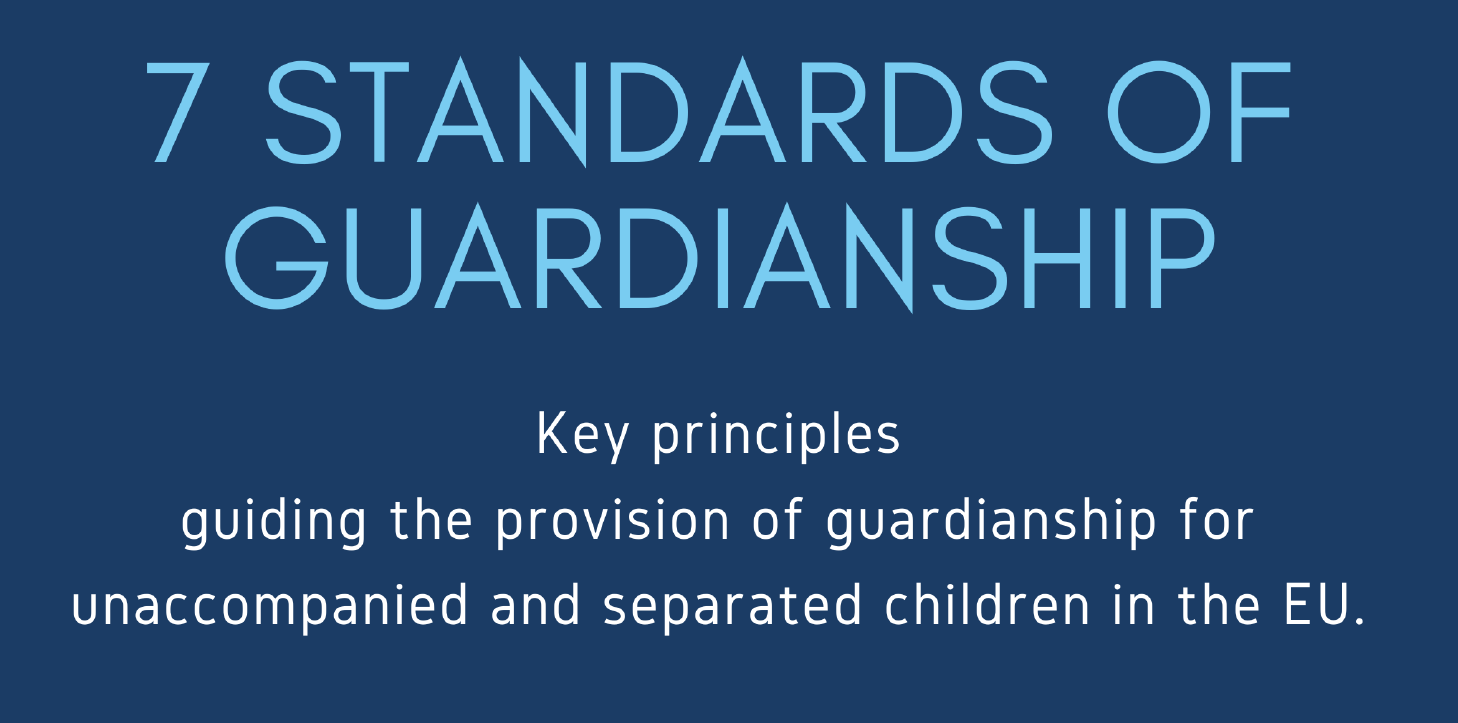
The EGN Standards for the delivery of guardianship to unaccompanied children set out the key principles which guide the provision of guardianship for unaccompanied children in the EU. They are rooted in provisions of the EU Charter of Fundamental Rights and the UN Convention on the Rights of the Child. Key sources are the European Commission and the Fundamental Rights Agency Handbook on guardianship for children deprived of parental care as well as the EU funded project ProGuard. A lot of the standards are already incorporated in the national guardianship systems, for example child participation.
The standards are important to give a common view and a baseline and are a good starting point to assess guardianship systems to improve them.
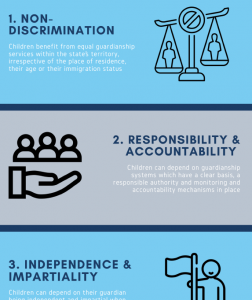
Infographic
Get to know the 7 standards. Click on the image to go to the PDF.
Translations
The standards of guardianship are now translated in 20 European languages:
- Bulgarian
- Croatian
- Danish
- Dutch
- Estonian
- Finnish
- French
- German
- Greek
- Irish
- Italian
- Latvian
- Lithuanian
- Maltese
- Polish
- Portuguese
- Romanian
- Slovenian
- Spanish
- Swedish
Child-friendly version
In a focus group with unaccompanied children (UAC) living in Greece, facilitated by Metadrasi, the children provided valuable feedback on how to make the standards more accessible and easier for young readers to understand. Based on their recommendations, we worked alongside a graphic designer from Nidos to create a colorful, engaging layout, featuring illustrations of guardians and UAC.
We encourage everyone to share this resource within your organisation to help ensure that children can fully understand the key responsibilities of a guardian in a way that’s clear and approachable.
EGN Child Friendly version of the standards